
🌻 SCROLL DOWN TO LISTEN TO THE SONG OF THE WEEK + WATCH THE EPISODE 🌻
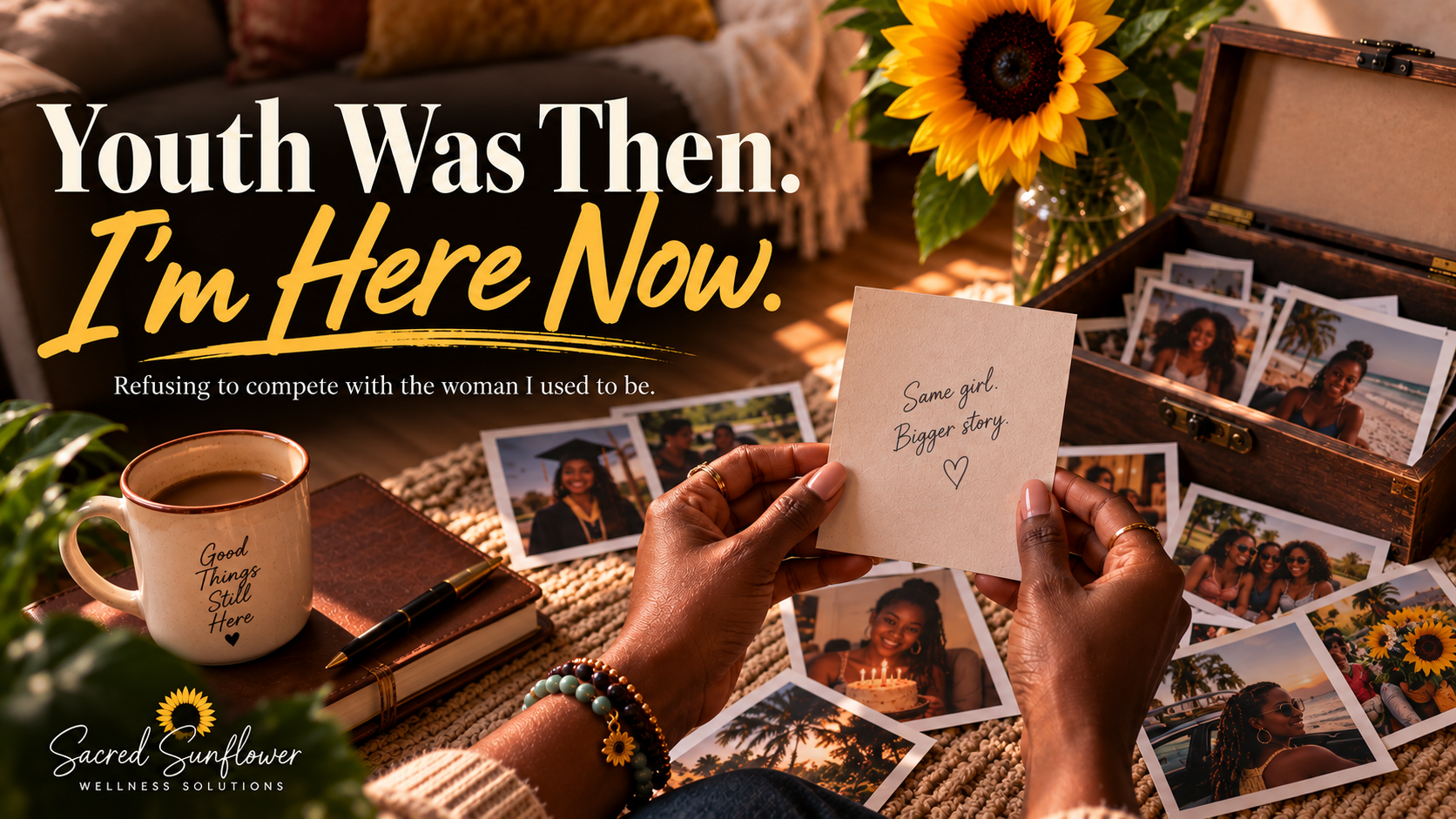
Still Becoming is an ongoing Sacred Sunflower Wellness conversation about menopause, midlife, identity, + the women we’re becoming. Episode 2, Youth Was Then. I’m Here Now continues this conversation about aging without turning our younger selves into the standard. If you haven’t listened to Episode 1, you can find it HERE.
Every now and then, an old picture stops me.
Not because I’m horrified by what I see, but it’s quite the opposite.
I’ll look at a younger version of myself and think, Well, damn, girl. You were fine.
And I was.
I can remember what I wore, where I was going, what was happening in my life, and some foolishness that happened five minutes after somebody took the picture. I can appreciate that woman. I can even miss things about her.
The problem starts when remembering turns into measuring.
An old photograph can go from being a fun memory to being a performance review real damn quick. Suddenly, I’m not simply looking at a younger version of myself. I’m comparing her body with mine. Her skin with mine. Her energy with mine. Her clothes with mine.
Underneath all of that is a question I didn’t realize I was asking:
Why am I evaluating how I look now by how I looked then?
Menopause + body image can make that question especially complicated because the body may be changing while we’re also surrounded by messages telling women that successful aging means making those changes as invisible as possible.
I won’t measure my current body against any previous version of myself.
Not because I’ve decided Younger Me was terrible.
Because she wasn’t.
She became me.
I’m here now.
Grown On Purpose
When Did Looking Younger Become the Standard?
Women weren’t just given rules about aging and beauty.
The rules were thrust upon them. Like, right at birth.
Shortly thereafter it’s: keep your skin smooth. Keep your stomach flat. Keep your hair done. Keep your nails done. Don’t let yourself go. Stay sexy. Stay desirable. Look good, but don’t look like you’re trying too hard. Have the baby and then hurry up and “get your body back.”
Get her body back from where?
She didn’t leave that bitch at the hospital.
She was right there, recovering from pregnancy and birth, while somebody was already suggesting that the body that had just done all of that needed to return to an earlier version of itself.
Then we get older, and the language changes, but the assignment doesn’t.
Reverse. Restore. Rejuvenate. Fight. Correct. Prevent.
Anti-aging itself is marketed as something we should actively pursue, as though aging is a process we might defeat if we buy the right serum, eat the right food, take the right supplement, move our bodies correctly, and maintain sufficient discipline.
Eventually, it becomes easy to confuse looking good with looking young.
Those aren’t the same thing.
I’m eager for us to see what happens when we have the courage to separate them.
Menopause, Body Image, + a Body That Keeps Changing
One of the things I appreciate about the research on menopause and body image is that it refuses to give us one neat little story.
There isn’t a universal experience where women reach menopause, hate their bodies, and need somebody to teach them self-love. Research has found a much more complicated relationship among menopausal symptoms, body image, aging, appearance, and how women experience their changing bodies.
That complexity matters to me because my body is changing.
I like my body. I like the way some of my clothes fit now. I feel strong. I work out because I want strength, mobility, and health that serve me for as long as possible.
I also experience bloating.
Sometimes I’m just bloated and pissed off.
There doesn’t need to be a self-esteem crisis hiding underneath it. I don’t need a journal prompt. I don’t need to stand naked in front of a mirror and thank my stomach for its service.
I just want the bloating to go the fuck away.
That doesn’t mean I hate my body.
Women in midlife have found this same kind of complexity: we can understand and challenge unrealistic appearance expectations while still experiencing the emotional effects of living in a culture saturated with them.
Knowing a rule is bullshit doesn’t automatically erase what decades of hearing it can do.
Rejecting the rule doesn’t require pretending every new symptom feels wonderful.
I Can Miss Her Without Wanting Her Back
This is where some conversations about positive aging lose me.
We’re so determined to tell women they should embrace aging that we sometimes leave them no room to say:
I miss that.
I miss how my body used to do this.
I miss how easy that used to be.
I liked my hair that way.
I liked those breasts.
I liked sleeping through the damn night.
Missing something isn’t the same as rejecting what exists right now.
Gratitude + grief can sit at the same table.
So can appreciation + irritation.
I can look at an old picture and think Younger Sophia was beautiful without turning around and deciding Current Sophia has failed because she doesn’t look like her.
She was me.
She was living.
She was learning.
She was surviving things.
She was becoming.
Good for her.
But she isn’t my competition.
That distinction feels especially important now because social media has made encounters with our younger selves almost unavoidable. Before social media, we could find an old picture while cleaning out a closet; now it can be in our feed as a memory: Here’s what you were doing 12 years ago today.
Well, thank you, Facebook.
My research involving midlife women has examined how conversations about looking “fat” or “old” can shape our body-related experiences.
I don’t need to win a contest against a woman who no longer exists.
I can remember her fondly and move tf on.
Wanting Relief Isn’t Wanting Youth
This distinction may be one of the most important ones for me.
If my knee hurts and I want it to stop hurting, I’m not chasing youth.
If I’m exhausted because I’m not sleeping well and I want better sleep, I’m not rejecting aging.
If sex becomes uncomfortable and I want answers or relief, I’m not asking anyone to restore my kewchie to its original factory setting.
If I’m dealing with hot flashes, bloating, irregular periods, or another symptom that interferes with my life, seeking support doesn’t mean I haven’t accepted my age.
Wanting relief isn’t wanting youth.
Acceptance doesn’t require enthusiasm.
Women have spent enough time being told how we’re supposed to look. We don’t need a new set of rules telling us how we’re supposed to feel about aging too.
Gray hair? Keep it. Dye it.
Makeup? Wear it. Don’t.
Heels? Sneakers? Both?
Do what works for the woman who has to live in the body.
The point isn’t proving that I’ve transcended vanity.
The point is autonomy.
I’m taking care of the woman who is here right now.
Looking Good Doesn’t Have to Mean Looking Young
“You look so young”
“You haven’t aged”
“You look good for your age”
Those things are meant to be compliments.
I’ve probably said some of them myself.
Now I find myself wondering what they really mean.
If telling a 50-year-old woman she looks 35 is supposed to make her feel good, what exactly have we decided 50 is supposed to look like?
What does 50 look like?
A 50-year-old woman.
There are a whole lot of ways to be one.
The more I think about it, the less interested I am in replacing anti-aging culture with another requirement that says every woman must proclaim herself beautiful at every stage of life.
Beauty can be wonderful.
I like looking good. I like feeling good in my clothes. I like doing things that make me feel put together.
But beauty isn’t the price of admission to being treated like a whole human being.
Beauty isn’t rent women owe the world for occupying space.
A woman doesn’t have to be beautiful for her age.
She doesn’t have to look younger than her age.
She doesn’t have to look “amazing” at all.
Her age doesn’t require an apology or approval from anybody.
Youth has never only been about appearance.
We attach youth to sexuality.
Desirability.
Energy.
Capability.
Relevance.
Visibility.
That’s why this conversation is about much more than discovering a few wrinkles.
When a culture treats youth as the most valuable version of womanhood, getting older can start to feel like you’re disappearing. The woman herself is very much still here.
I’m not interested in disappearing.
I’m also not interested in impersonating a younger version of myself to remain visible.

My Current Body Isn’t an After Picture
We love before-and-after pictures.
They tell a satisfying little story.
Here’s where I started.
Here’s where I ended.
Transformation complete.
Except bodies don’t work that way.
This isn’t my before body.
This isn’t my after body.
It’s my current body.
It’s the one carrying me through my life.
So I move it.
I strengthen it.
I feed it.
I pay attention when something feels different.
I want to preserve my mobility because I enjoy being independent. I want strength because I plan on using it. I want to be able to get up off the floor without negotiating with Jesus.
My goals are about caring for myself.
I don’t want “healthy aging” to become another socially acceptable way to demand that women preserve their looks indefinitely.
Eventually I’m going to change again. You will too.
That’s just how it is.
There will be a 60-year-old Sophia.
If I’m blessed, there will be a 90-year-old Sophia.
She doesn’t owe anybody an explanation about her body or looks. That version of me will be thankful to this version of me for all she did to sustain life.
I have to see things this way because I don’t want to spend my fifties proudly refusing to look 30 and then reach my sixties furious because I no longer look 50.
Same assignment. New reference photo.
No, ma’am.
We’re not doing that either.
Youth Was Then. I’m Here Now.
I don’t know who first taught us that youth was supposed to be the goal.
It probably wasn’t one person.
It was advertising. It was entertainment companies. It was compliments. It was conversations between women and things people said without thinking.
The message came from enough directions that it eventually felt like common sense.
That doesn’t mean I think looking younger is a bad thing.
That’s the part I don’t want you to misunderstand.
I am not at war with the woman I used to be.
I can look back.
I can miss things.
I can laugh at an old picture and say, Damn, girl. You were fine.
I can be grateful for her. I can grieve pieces of her. I can recognize everything she survived and everything she didn’t know yet.
But I also don’t need to become her again.
She became me.
Someday, the woman I am right now will be an old photograph.
Maybe 70-year-old me will find a picture from this season and smile.
Maybe she’ll shake her head at something I was wearing.
Maybe she’ll say, Girl, you were doing your thing.
I hope she appreciates me.
I hope she’s gentle with me.
I hope she puts the damn picture down and gets back to living her own life.
Because she won’t owe me anything either.
Youth was then.
I’m here now.
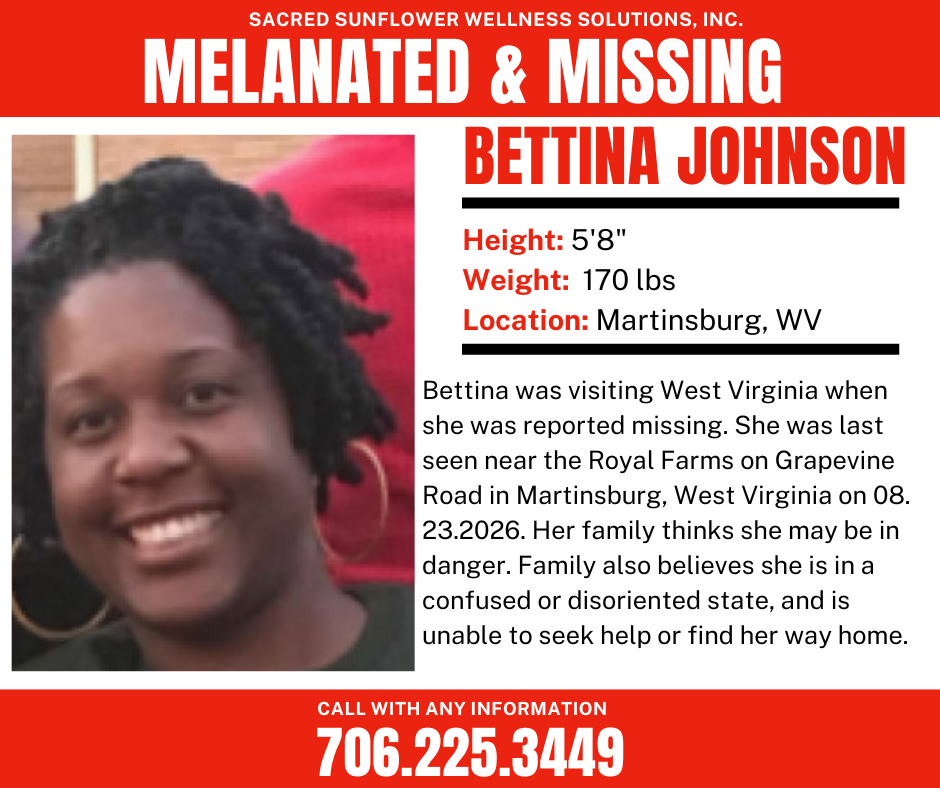
Bettina Johnson, 42, has been missing since August 23, 2026. She was visiting West Virginia and was last seen near the Royal Farms on Grapevine Road in Martinsburg. Her family believes she may be in danger and may be confused or disoriented, making it difficult for her to seek help or find her way home.
Bettina is described as:
- Black woman, medium complexion
- 5’8″, approximately 170 lbs.
- Black, medium-length hair
- Brown eyes
If you have seen Bettina or have information that may help locate her, please contact the Berkeley County Sheriff’s Department at (304) 267-7000 or Black and Missing Foundation at 877-97-BAMFI.
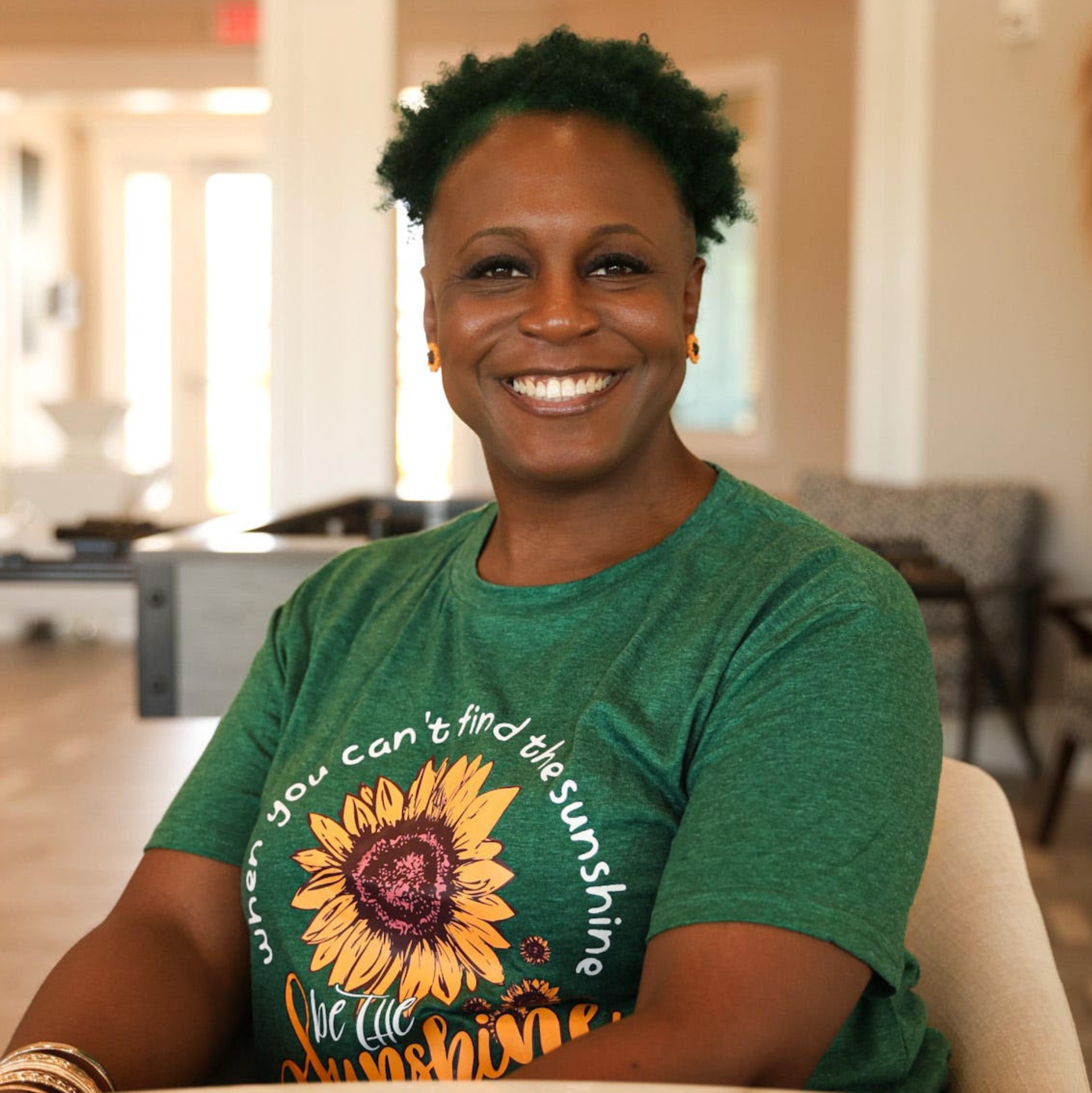
Sophia Antoine
Wellness Practitioner
Sophia Antoine is a full-spectrum doula, wellness coach, relationship coach, and founder of Sacred Sunflower Wellness Solutions. She creates soft-but-honest spaces for people navigating birth, postpartum, grief, chronic illness, emotional wellness, relationships, and major life transitions. Her work is rooted in autonomy, self-awareness, reproductive justice, and the belief that people deserve to feel supported, heard, and cared for while they are still in the middle. Through Serenity Before Sunrise, Sophia offers reflections, workbooks, and gentle practices for those learning how to stop rushing past themselves and return to their own care.